Five people, two bathrooms, and one hot water system that is trying to keep up. Someone starts the dishwasher while two showers are running, and suddenly, the third person in line has to deal with a cold shower halfway through washing their hair. It happens in big households all the time, and the hot water system usually gets the blame.
The best hot water system for a large family is a heat pump (270 to 315L) for long-term savings and rebate eligibility, or a gas continuous flow unit (26L/min or higher) if you want endless hot water and have natural gas connected. Both outperform electric storage water heaters for households of five or more people.
Hot water accounts for roughly 25% of the average Australian household energy bill. Choosing the wrong system means either running out constantly or paying too much to heat water you never use. For a household of five or more people using multiple bathrooms, a dishwasher, and a washing machine, that adds up fast.

Types of Hot Water Systems Compared for Large Families
Electric Storage Hot Water Systems
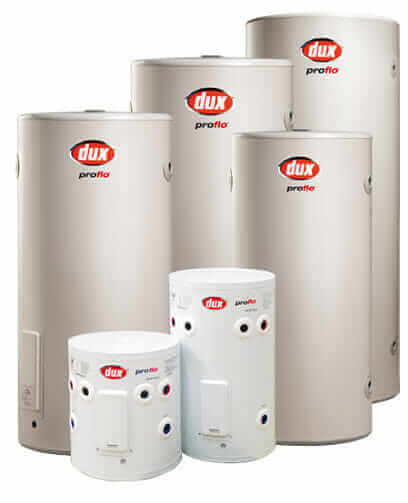
An electric element heats cold water inside an insulated storage tank, keeping it ready for use. Heat loss from storage tanks is a real issue, especially with older or poorly insulated units, because the system has to keep reheating water even when no one is using it. For a large family, you’ll need a 315L to 400L tank, and twin-element models like the Dux Proflo 400L that heat water faster than single-element units.
Electric storage water heaters are the cheapest to buy, typically $1,000 to $2,500 installed. But they have the highest running costs of any system type at $1,200 to $1,500 per year, adding up to thousands of dollars in wasted energy over a decade.
Recovery rates are slow, so once the tank runs out during peak morning or evening use, you’ll have to wait. These systems can be installed indoors or outdoors, though indoor installations need a floor drain and adequate ventilation.
Off-peak electricity tariffs add another layer to this. Off-peak heating means your system reheats only overnight using grid electricity at cheaper rates, so you need a larger tank than you’d otherwise need.
A family of five on off-peak with a 250L tank will almost certainly run out by the evening. You need at least 400 L minimum. It’s worth checking with your energy provider to see which tariff options are available before committing to a tank size.
Verdict: Budget-friendly upfront, but the most expensive to run long-term. Best as a like-for-like replacement when switching system types isn’t feasible.
Gas Storage Hot Water Systems
Gas storage systems heat water in a tank using a gas burner, with much faster recovery than electric models. The Rheem Stellar 360 is a standout here. It has a 160L tank but delivers 360 litres in the first hour and recovers at 200L per hour, which is faster than any other gas hot water system on the market.
That first hour rating is actually more useful than raw tank size when working out whether your family will run out of hot water. It measures how much hot water the system can deliver during its busiest hour, factoring in both stored water and how quickly it reheats. A gas storage system with a high first-hour rating will outperform a much larger electric tank with a slow recovery rate.
Gas storage hot water systems suit households with natural gas connected. If you’re on LPG, running costs are much higher, sometimes double what you’d pay on natural gas, so make sure you work that cost out before choosing gas over other options. Modern gas storage units use electronic ignition rather than a standing pilot light, which saves gas and improves safety.
Verdict: Solid mid-range choice with faster recovery than electric. Best if you already have natural gas.
Gas Continuous Flow (Instantaneous)
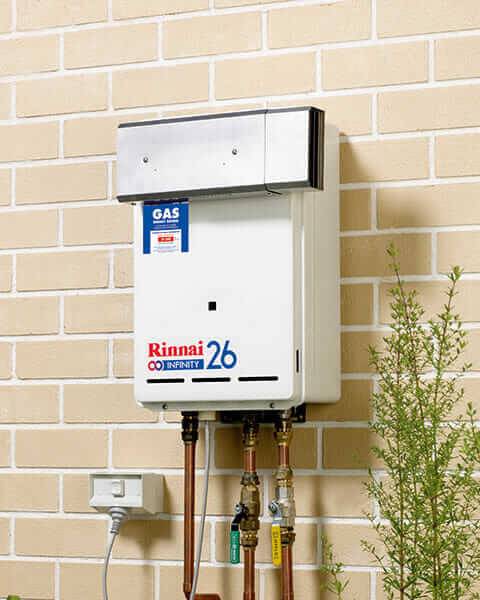
A continuous flow gas system heats water on demand as it passes through a heat exchanger. And there’s no storage tank, so you never run out. Units like the Rinnai B26 and Rheem Metro 26 deliver 26 litres per minute, which suits most large households.
The main consideration for big families is matching the flow rate to your simultaneous usage. Two showers running at once, plus a dishwasher, draw roughly 21 L/min, so a 26 L/min continuous-flow hot water system handles that comfortably. A household with three bathrooms, all in use, may want a 32 L/min unit or dual units.
Continuous-flow models are compact and wall-mounted, saving floor space. They heat only the water you actually use, which means less wasted energy than storage systems, where heat loss is constant. Running costs for natural gas sit at around $400 to $600 per year.
Before buying, check your gas supply and pipe sizing needs to support the higher gas demand. Upgrading gas pipework adds to the installed cost, and most people don’t budget for it.
Verdict: Excellent for large families who want endless hot water. Check that your gas supply can handle it.
Heat Pump Hot Water Systems
A heat pump works like a reverse-cycle air conditioner for water. They extract heat from the surrounding air through a compressor and refrigerant cycle, then transfer it to water in an insulated tank. This process uses up to 70% less electricity than a standard electric storage system, making it one of the most energy-efficient options available.
For a family of five, a 270L to 315L heat pump unit is recommended. Families with six or more should consider 315L models. The Stiebel Eltron 302L is a popular choice for households of four to six people, while larger families may need to explore the upper end of the range.
Running costs are the lowest among all system types, at around $300 to $400 per year. That’s roughly $900 less per year than an electric storage water heater, which means the heat pump pays for itself within a few years.
Because heat pumps draw heat from the surrounding air rather than generating it directly from grid electricity, they also significantly reduce carbon emissions compared to electric and gas systems.
Government rebates make heat pumps even more competitive in terms of upfront cost. The main programs available in 2026 are:
- Federal STCs (Small-scale Technology Certificates): An upfront discount of typically $500 to $700, depending on your zone and the model installed. Available nationwide.
- Victoria: STCs can be stacked with the Victorian Energy Upgrades (VEU) program and the Solar Victoria hot water rebate (up to $1,000, or $1,400 for locally-made units) for combined savings of $1,500 to $2,500+, depending on the system and certificates.
- NSW: Energy Savings Certificates (ESCs) under the Energy Savings Scheme provide an additional upfront discount when replacing an existing electric or gas system.
- Queensland: STCs apply, but state-level programs are limited compared to VIC and NSW.
Heat pumps have a slower recovery rate than gas systems and perform best in moderate climates. In cold weather and cold climates, efficiency drops, though modern units handle this much better than older models. They also produce some noise from the outdoor compressor and fan assembly, similar to a small air conditioning unit. The heat pump unit needs to be installed outdoors with adequate clearance around the compressor for airflow.
Verdict: Best long-term value for large families. Lowest running costs, rebate-eligible, and suits most Australian climates. The top recommendation for households upgrading from electric storage.
Solar Hot Water Systems
Solar hot water systems use roof-mounted collectors (flat-plate or evacuated-tube) to heat water using solar energy. A gas or electric booster tops up heating on cloudy days and during high-demand periods. Solar panels capture free energy, and the booster only kicks in when solar heating falls short.
Large families typically need a 300L to 360L storage tank with collectors and a booster. Running costs are very low at $50 to $200 per year when conditions are right, and the lifespan is 15 to 20 years.
The trade-offs are a high upfront cost ($4,000 to $8,000+ installed), the need for suitable roof space and orientation, and dependence on weather. Solar hot water systems also qualify for STCs.
Verdict: Excellent if you have the roof space and budget. Best combined with a gas booster for reliable hot water in a large household.
How Much Hot Water Does a Large Family Actually Use?
The commonly quoted figure is 50 litres per person per day, but that’s a baseline. Real-world usage in a house with teenagers and a bath can be significantly higher, at around 70-76 litres per person.
To put it in perspective, think about a weekday morning in a five-person home. Two parents shower before work, the kids get ready for school, the dishwasher kicks off, and someone throws on a hot wash. That’s easily 250 to 270 litres of hot water gone before 8 am, and nobody has run a bath.
Hot water usage tends to rise as kids get older and start taking longer showers, running their own loads of washing, and generally using more water. A system that handled things well when the kids were small can start to fall short a few years later. If your household’s hot water needs have grown, it’s worth sizing for where you are now rather than where you were when the system went in.
Quick-Reference Sizing Table
| Household Size |
Daily Usage Estimate |
Recommended Storage Size |
Recommended Continuous Flow Rate |
| 5 people |
250 to 380L |
315 to 400L |
26L/min+ |
| 6 people |
300 to 460L |
400L+ |
26 to 32L/min |
| 7+ people |
350 to 530L+ |
400L+ or twin system |
32L/min or dual units |
What Size Hot Water System Does a Family of 5, 6, or 7 Need?
Choosing the right system size depends on the system type, not just on the number of people in your household. Here’s how it breaks down.
Electric storage:
A family of five needs at least 315L, and 400L is safer if you’re on an off-peak tariff. Families of six or more should go 400L.
Gas storage:
Five people suit 260L to 360L, depending on the first hour rating. Six or more should look at 360L+ with a high recovery rate.
Heat pump:
A 270L to 315L heat pump hot water system comfortably serves five to six people. Larger families should target 315L models.
Gas continuous flow:
Five people need 26L/min minimum. Households with six or more people and multiple bathrooms running simultaneously should consider 26-32 L/min or dual units.
Also consider how many bathrooms you have, whether your dishwasher and washing machine use hot water, and whether you’re on a controlled-load or off-peak electricity plan.
Considerations Before You Buy
| Consideration |
What to Think About |
| Energy source |
Do you have natural gas, or is LPG your only gas option? What electricity tariff are you on? |
| Climate and location |
Heat pumps suit moderate climates (QLD, NSW, VIC). Solar suits sunny regions (QLD, WA, SA). Gas continuous flow works everywhere. |
| Available space |
Storage tanks need floor space. Continuous flow units are wall-mounted. Heat pumps need outdoor clearance for airflow. Some electric systems can be installed indoors. |
| Upfront cost vs. running cost |
Electric storage: ~$1,500 installed, $12,000 to $15,000 to run over 10 years. Heat pump: $3,000 to $5,000 installed (before rebates), $3,000 to $4,000 to run over 10 years. |
| Government rebates |
Federal STCs reduce upfront costs for heat pumps and solar. State programs in VIC, NSW, and SA add further savings. Can make a heat pump price-competitive with electric storage. |
| Recovery rate |
Gas is fastest, then heat pumps, then electric storage. Critical for large families during peak morning and evening use. |
Our Top Recommendations for Large Australian Families
These are our picks based on over 30 years of helping Australian families find the right hot water system.
Best overall for large families: A heat pump hot water system (270 to 315L). Lowest running costs, eligible for government rebates that bring the upfront cost down substantially, and suits most Australian climates. If you’re upgrading from an old electric storage system, a heat pump is the strongest option available.
Best for endless hot water: Gas continuous flow at 26L/min or higher. You’ll never run out, it only heats water you use, and it’s compact. Ideal if you have natural gas connected and multiple bathrooms.
Best budget option: Electric storage 400L. Lowest upfront cost when you need a straightforward like-for-like replacement. Just be aware of the higher running costs and energy consumption over time.
Best for eco-conscious families: Solar hot water with a gas booster. Lowest environmental impact and very low running costs in sunny regions. Worth the higher upfront investment if you have suitable roof space and orientation.
We stock all major brands, including Rheem, Rinnai, Dux, Vulcan, Aquamax, Bosch, Stiebel Eltron, Evoheat, Quantum, and Thermann.
Choose the Right Hot Water System for Your Family
Large families need a hot water system matched to their actual usage patterns, not just the biggest water tank on the shelf. First hour rating, recovery rate, and how your household uses hot water throughout the day all matter more than raw capacity alone.
Same Day Hot Water Service stocks all major brands and system types, with competitive pricing and same-day installation available in Sydney, Newcastle, Central Coast, Wollongong, Melbourne, Brisbane, Sunshine Coast, Perth, and Canberra.
If you’re ready to upgrade or want help sizing the right system for your household, give us a call on 1300 721 996.
Frequently Asked Questions
What is the best type of water heater for a large family?
For most large families, a heat pump hot water system offers the best balance of capacity, efficiency, and long-term cost. It uses up to 70% less electricity than standard electric storage water heaters and qualifies for government rebates that significantly reduce the upfront price. If you prefer endless hot water on demand, a gas continuous flow system rated at 26L/min or higher is an excellent alternative.
What is the most efficient hot water system in Australia?
Heat pump hot water systems are the most energy-efficient option available. They extract warmth from the surrounding air using a small amount of electricity, achieving an efficiency ratio of 3 to 4. That means they produce three to four times as much heat as they consume in electricity. Solar hot water systems are also highly efficient but depend on weather and roof conditions.
What size hot water system for a family of 4 in Australia?
A family of four typically uses 200 to 300 litres of hot water per day. A 250L to 315L storage system or a 20 to 26L/min continuous flow system will suit most four-person households. A heat pump water heater in the 250L to 270L range is also a strong choice, offering significant energy savings compared to an electric storage heater.
What is the best hot water system for a large house?
A large house with multiple bathrooms needs a hot water system that can deliver hot water to several outlets simultaneously. Gas continuous flow hot water systems at 26 to 32L/min are ideal because they provide unlimited hot water at mains pressure. Alternatively, a high-capacity heat pump (315L) paired with a timer to heat during solar hours or off-peak rates provides excellent energy efficiency for a large house with high hot water demands.